

Rheumatoid arthritis Heidelberg
Help for inflammatory joint pain
Rheumatoid arthritis is the most common rheumatic disease.
Typical features are inflammatory joint pain (especially at night), joint swelling (arthritis), soft-tissue swelling and morning stiffness. In principle, any joint can be affected, but the small joints of the hands and feet are involved most often, frequently in a symmetrical pattern. Large joints such as the shoulders, knees or hips may also be affected.
The work-up includes differentiated immunological testing, which we offer in our practice’s own immunology laboratory. The best-known laboratory value is probably the rheumatoid factor, but more specific and more informative markers are now available, which an experienced rheumatologist interprets together with the clinical complaints and imaging findings. Importantly, a normal rheumatoid factor does not rule out a rheumatic disease – and in particular not rheumatoid arthritis.

Symptoms of inflammatory joint pain
When taking the history, we pay particular attention to the character of the pain. Typical of rheumatic diseases are:
- pain that is worst at rest
- pain at night and in the morning
- improvement with movement
- often an insufficient response to anti-inflammatory painkillers
Morning stiffness
Morning stiffness in inflammatory rheumatic diseases can hamper patients in everyday life for several hours. It must be distinguished from the brief “start-up” pain of degenerative diseases.
General symptoms
In addition to joint and tendon complaints, non-specific general symptoms such as fatigue and exhaustion can point to a rheumatic disease. Reports of night sweats, weight loss and raised temperature are also notable.
Diagnosing rheumatoid arthritis
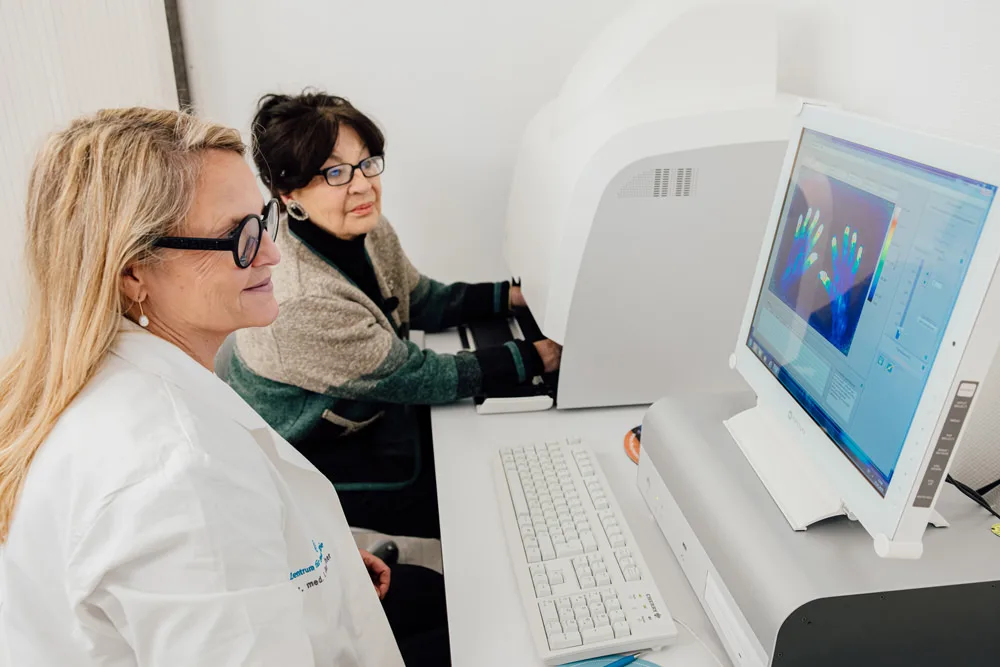
The most important diagnostic element is a detailed and comprehensive medical history. A thorough physical examination with assessment of all joints points the way. This is supplemented by extensive laboratory testing. Imaging includes conventional X-rays of the hands and feet, as these are the hallmark joints of rheumatoid arthritis. Where necessary, the rheumatologist also arranges a joint ultrasound, an MRI scan, a bone scintigraphy or a Xiralite® examination (fluorescence-optical imaging of inflammation in the hands).
The findings fit together like a puzzle. The experienced rheumatologist assesses the overall picture from the clinical complaints, the extensive laboratory tests and the imaging findings.
At the initial consultation at the Centre for Rheumatology, we usually take an hour and explain the findings in detail.
More about diagnostics
Timeline as text
- 1894 antimalarial drug/Quensyl®
- 1920 Gold
- approx. 1942 (1947) sulfasalazine
- 1947 cortisone
- 1951 cyclophosphamide
- 1952 methotrexate 1948
- 1964 azathioprine 1959
- 1979 ciclosporin A
- 1999 leflunomide
- 2000 Infliximab/Remicade®, Etanercept/Enbrel®
- 2002 Anakinra/Kineret®, Canakinumab/Ilaris®
- 2003 Adalimumab/Humira®
- 2007 Rituximab/Mabthera®
- 2008 Abatacept/Orencia®
- 2009 Tocilizumab/Roactemra®, Golimumab/Simponi®
- 2010 Certulizumab/Cimzia®
- 2011 Belimumab/Benlysta®
- 2013 Ustekinumab/Stelara®
- 2014 Apremilast/Otezla®
- 2015 Sekukinumab/Cosentyx®
- 2017 Baricitinib/Olumiant®, Tofacitinib/Xeljanz®
- 2018 Ixekizumab/Taltz®
- 2020 Guselkumab/Tremfya®, Upadacitinib/Rinvoq®, Filgotinib/Jyseleca®
- 2021 Mepolizumab/Nucala®
- 2022 Avacopan/Tavneos®, Risankizumab/Skyrizi®, Anifrolumab/Saphnelo®
Treating rheumatoid arthritis
The treatment of rheumatoid arthritis involves several groups of drugs.
Initially, anti-inflammatory painkillers (NSAIDs) such as ibuprofen or diclofenac are often used. Once the rheumatologist has confirmed the diagnosis, long-term NSAID use is avoided because of possible side effects and usually inadequate disease control.
Glucocorticoids (steroids, cortisone) are the first choice for achieving rapid improvement of inflammatory disease activity and pain, and for relieving acute pain. The aim is a limited, as short as possible course of steroids until the specific antirheumatic drugs (DMARDs) take effect.
Read more
These drugs are also known as DMARDs (disease-modifying antirheumatic drugs). For highly active disease, methotrexate (MTX) has been the first-line drug since around 1950. Because it is more effective that way, it is now usually injected into the subcutaneous fat with a small pre-filled syringe or pen.
There are many alternatives to MTX, chosen according to disease activity, complaints, concomitant diseases and the patient’s age: sulfasalazine, hydroxychloroquine (Quensyl), leflunomide and ciclosporin. Depending on disease activity, these drugs can be used alone or in combination.
For around 20 years, biologics (bDMARDs, biological DMARDs – biotechnologically produced antibodies) have revolutionised treatment. They are used for more aggressive disease, intolerance or failure of conventional DMARDs. The indication follows guideline recommendations and takes concomitant diseases into account.
In the hands of an experienced rheumatologist, drug treatment of inflammatory rheumatic diseases is safe. Treatment is tailored to each patient with a holistic view.
At our rheumatology practice in Heidelberg, our experienced specialists are there for you personally and individually. We advise you on all questions about your condition and carry out comprehensive diagnostics. You are welcome to make an appointment.
Back to all services
Make an appointment